

Key Takeaways
- Title errors in out-of-state vehicle registration often stem from outdated fee tables, missing documentation requirements, and manual data entry mistakes that car title software can prevent.
- Real-time DMV data gives dealers accurate, jurisdiction-specific information at the moment of transaction, reducing rejections and compliance risk across all 50 states.
- ATC’s Dealer Portal combines live transaction tracking, document validation through Pre-Audit, and guided quoting to help title desks catch errors before they reach the DMV.
Title errors are one of the most predictable problems in automotive retail, and one of the most preventable. For dealerships that handle out-of-state transactions, the stakes are especially high. A single missing document, an incorrect fee calculation, or an outdated registration requirement can trigger a DMV rejection, delay funding, and frustrate a customer who expected a smooth purchase. The good news is that modern car title software connected to live DMV data can catch those errors before they become problems.
This article breaks down how real-time DMV data works, where title errors most commonly originate, and how the right tools give your title desk visibility and control over every transaction.
Where Title Errors Come From
Most title errors are not the result of carelessness. They are the result of complexity. Out-of-state title and registration involves thousands of variables: state-specific tax rates, county-level registration fees, documentation checklists that vary by transaction type, lien requirements, odometer statement rules, and more. According to industry data, manual entry errors occur in approximately 20% of transactions, and out-of-state registrations can account for up to 30% of a dealership’s total volume.
When dealerships rely on static reference materials, internal spreadsheets, or outdated data to calculate fees and assemble document packages, errors are nearly inevitable. By the time a DMV rejection arrives, the deal has often already funded, the customer has taken delivery, and the cost of fixing the problem falls entirely on the title desk.
What Real-Time DMV Data Actually Does
Real-time DMV data eliminates the guesswork. Rather than pulling from a reference table that may be weeks or months out of date, a system connected to live DMV sources retrieves current fee structures, documentation requirements, and jurisdiction-specific rules at the moment a transaction is initiated.
ATC’s DMV Data API is built on a database spanning more than 19 million combinations of required inputs, covering all 11,000-plus U.S. jurisdictions. That means when a dealer submits a transaction, the system is working with the same pricing data that comes directly from local DMVs, enabling accurate quotes with confidence. There is no manual lookup, no cross-referencing between browser tabs, and no uncertainty about whether the information is current.
For out-of-state vehicle registration specifically, that level of accuracy matters enormously. Rules that apply in one state do not apply in another. A car registered in Texas follows a completely different set of requirements than one registered in Colorado or California. A system that can surface the correct checklist, fees, and documentation requirements for each individual transaction is not a convenience, it is a compliance necessity.
How the ATC Dealer Portal Puts This Into Practice
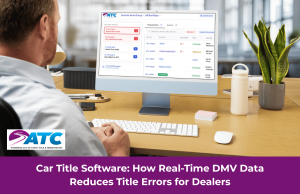
Understanding real-time data is one thing. Having it integrated directly into your title desk workflow is another. ATC’s redesigned Dealer Portal is built around three capabilities that work together to reduce errors at every stage of a transaction.
Pre-Audit: Catching Errors Before They Reach the DMV
The Pre-Audit tool validates document packages before submission. Rather than discovering a missing form or an incorrect figure after a DMV rejection, dealers get a clear signal earlier in the process. This is the same kind of quality control that ATC’s internal auditing team applies, with a less than 48-hour turnaround on file auditing and processing to eliminate errors before filing with the DMV. Pre-Audit brings that discipline to the front end of the transaction.
For title desks managing high volumes of automotive title compliance work across multiple states, Pre-Audit is a meaningful efficiency gain. Fewer rejections mean fewer callbacks, less rework, and faster receipt of funds.
Dashboard and Live Transaction Tracker
The Dashboard gives title desk staff real-time visibility into the status of every active transaction from a single view. Instead of following up with account managers or waiting for status updates, dealers can see exactly where each file stands. This transparency reduces the risk of transactions stalling unnoticed and gives managers a clear picture of workload and pipeline.
ATC has always prioritized real-time tracking as a core part of its service model. The Dashboard formalizes that visibility into a tool that title desk staff can use independently, without needing to contact their account manager for a status check.
Guided Quote Builder
Accurate quoting is where title and registration software earns its keep on the front end of a deal. ATC’s Guided Quote Builder walks dealers through the transaction inputs and surfaces the correct fees and documentation requirements for the specific jurisdiction. Because pricing data comes directly from local DMVs, dealers can quote instantly with confidence rather than estimating and correcting later.
The Cost of Getting It Wrong
Title errors carry real financial consequences. Penalties and fines from DMV rejections, delays in receiving cash from funded deals, and the administrative burden of reworking files all add up quickly. ATC’s data suggests that faster processing alone, enabled by cleaner submissions, can accelerate cash receipt by 8 to 20 or more days per transaction, a meaningful impact on dealership cash flow.
Beyond the financial impact, errors create friction in the customer relationship. A buyer who has to wait weeks longer than expected for plates or registration documents because of a title problem is not a buyer who refers their friends. Reducing errors through better dealer title management is, ultimately, a customer experience investment.
Why Out-of-State Specialization Matters in a Software Partner
Not all title and registration software is built the same way. Some platforms treat out-of-state titling as a secondary feature, a checkbox alongside a broader menu of in-state processing tools. ATC’s entire focus is out-of-state title and registration, and that focus is reflected in the depth of the data, the accuracy of the tools, and the experience of the team behind them.
With more than 30 years in the industry and a processing team with 300-plus cumulative years of experience, ATC has built its platform around the specific challenges of out-of-state transactions. The DMV Data API, the Pre-Audit tool, and the Dealer Dashboard are not general-purpose tools repurposed for titling. They are purpose-built for the work dealers actually do.
Frequently Asked Questions
What is car title software, and how does it differ from general DMS titling tools?
Car title software is a dedicated platform for managing title and registration processing, including fee calculation, document checklist generation, submission tracking, and compliance validation. Unlike the titling modules built into general dealer management systems, purpose-built car title software is designed specifically around DMV requirements and typically offers deeper jurisdiction coverage and more accurate real-time data.
How does real-time DMV data reduce title errors?
Real-time DMV data ensures that fee calculations, documentation requirements, and registration rules reflect current state and county-level requirements rather than static reference tables that may be outdated. When a dealer initiates a transaction, the system pulls live data for that specific jurisdiction, reducing the risk of submission errors caused by stale information.
What does Pre-Audit do that manual review cannot?
Pre-Audit systematically checks a document package against jurisdiction-specific requirements before submission, flagging missing or incorrect items that a manual review might miss, especially under high-volume conditions. It applies consistent validation logic across every transaction rather than relying on individual attention to detail.
Does ATC handle out-of-state registrations in all 50 states?
Yes. ATC processes out-of-state title and registration transactions across all 50 states and covers more than 11,000 U.S. jurisdictions through its DMV Data API. This nationwide coverage is core to ATC’s model as a dedicated out-of-state processing partner for dealerships.
How does the Dashboard help title desk staff manage their workload?
The Dashboard provides a single real-time view of all active transactions and their current status. Title desk staff can see where each file stands without contacting their account manager for updates, which reduces administrative follow-up time and makes it easier to prioritize and monitor pending work.
Automotive Titling Company (ATC) has been simplifying out-of-state title and registration processing for dealerships across the country for more than 30 years. To learn how ATC can support your title desk, visit autotitling.com.